
Documentation
- Descriptive information about Nomenclature
- Semantic Model Documentation
Descriptive information about Nomenclature
Machine-readable information describing the Nomenclature dataset and ontology is provided to allow semantic agents to more easily find, register, summarize, analyze, and consume Nomenclature linked data. Information on Nomenclature’s content, structure, licensing, access, properties and classes, and basic statistics are included. The main ontology used in this descriptive file is the Vocabulary of Interlinked Datasets (VoID). The Data Catalog Vocabulary (DCAT), the Asset Description Metadata Schema (ADMS) and others are also used.
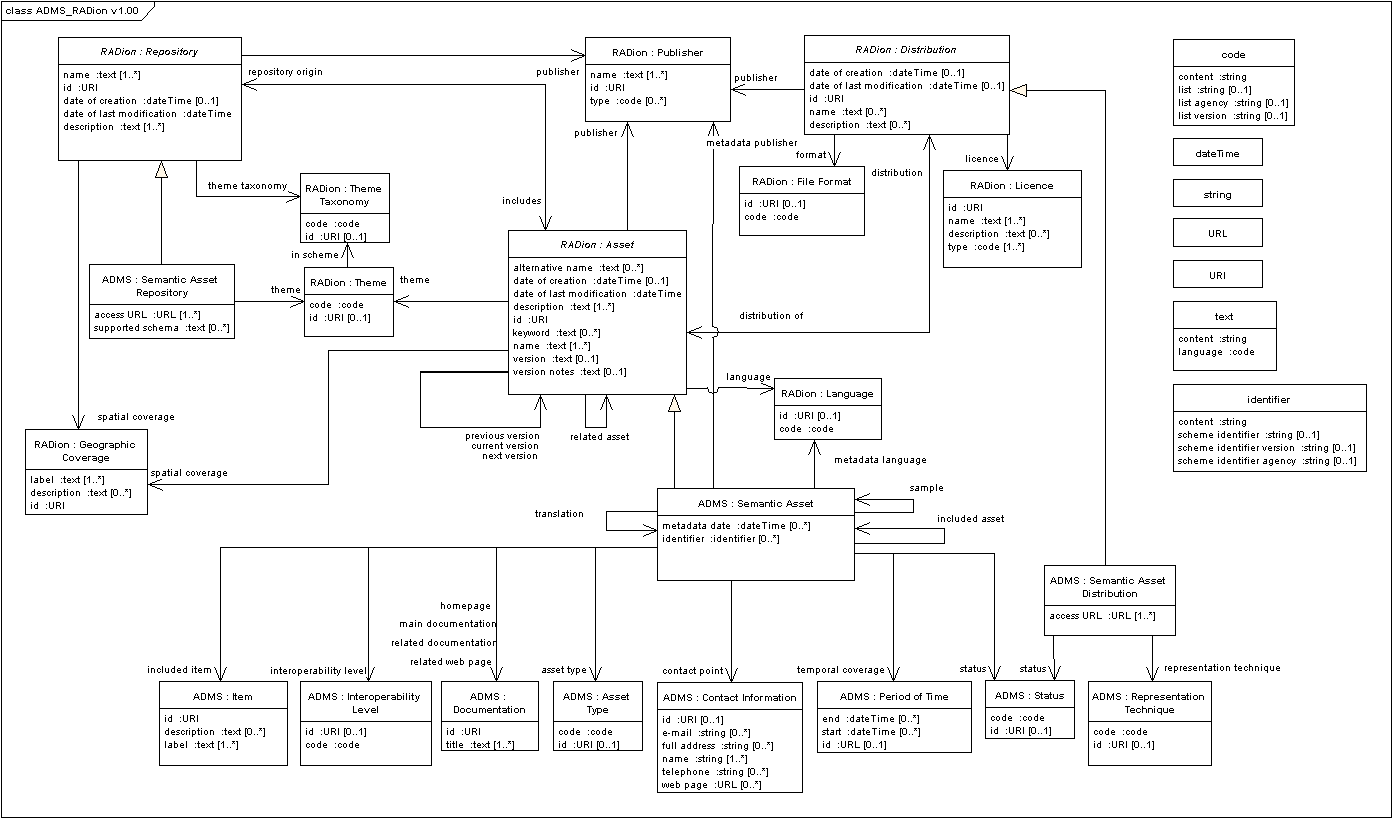
This file is updated nightly to refresh dynamic information such as number of concepts, number of triples, and date of last update. It is provided to facilitate automatic discovery.
The following files contain the same descriptive information about Nomenclature, but in different RDF serializations. The Turtle (.ttl) version includes comments and arrangement that make it more human-readable.
The following link will re-direct to either a Turtle, JSONLD, or RDF/XML file, depending on your HTTP header request. By default, the semantic HTML view will be returned.
Semantic Model Documentation
Version: 1.0
Created date: 2022-05-02
Last update: 2023-01-30
This document aims to describe the semantic model of Nomenclature. It was designed for an audience particularly interested in using the SPARQL endpoint of Nomenclature, whether to write a new query or modify an existing one. This documentation is also relevant for those who download the full dataset in RDF/XML, Turtle or JSON-LD format.
Users who do not wish to use semantic web technologies to interact with Nomenclature can browse the hierarchy, search for terms or download the entire current vocabulary in Excel format.
To become familiar with the model, it is recommended to explore the predefined SPARQL queries that provide access to the most frequently requested information. If the provided SPARQL queries do not meet the operational needs of the user, this documentation describes the semantic data structure present in the model.
Graphs
Five named graphs make up Nomenclature's semantic dataset. Each of them uses different standards.
- Thesaurus Graph: Main graph where the user can find all the current data related to Nomenclature's active concepts. URI: https://nomenclature.info/nom/thesaurus
- Descriptive Metadata Graph: This graph contains all data about the Nomenclature dataset. For instance, this is where the user can find Nomenclature's contributors and total number of triples. URI: https://nomenclature.info/nom/.well-known/void
- Concept History Graph: This graph contents data related to historical changes to Nomenclature’s concepts. URI: https://nomenclature.info/nom/hist
- Deprecated Concept Graph: This graph contains minimal data about concepts that are deprecated from Nomenclature concept scheme. URI: https://nomenclature.info/nom/obsolete
- Nomenclature Ontology Graph: This last graph contains all the entities used in the Nomenclature Ontology. It includes external and internal standards. This document also describes peripheral entities mandatory to describe Nomenclature's concepts (e.g. agents, language, levels, etc.). URI: https://nomenclature.info/nom/onto/
Each active concept’s per-entity RDF contains combined data from the Thesaurus, Concept History and Nomenclature Ontology Graphs. Other entities’ per-entity RDF contain only direct incoming and outgoing triples.
Standards
External Standards
Nomenclature's data model reuses several different standards in order to present the required semantics with high precision. These standards can be divided into two categories: Ontologies and Vocabularies (even if in some cases the differences are blurry). Most of them are represented with a prefix. A prefix acts like a variable to replace a longer URI path.
External ontologies
If the ontology is used in any of the following graphs, it can also be found in the concept’s per-entity RDF:
- Nomenclature ontology
- Thesaurus
- Concept History
If the prefix is not associated with any graph (value "None" in the "Graph(s)" column), it is only used to generate the data internally.
| Prefix | URL | Name | Graph(s) |
|---|---|---|---|
| adms: | http://www.w3.org/ns/adms# | Asset Description Metadata Schema | Descriptive Metadata |
| cc: | http://creativecommons.org/ns# | Creative Common Rights Expression Language | Descriptive Metadata |
| crm: | http://www.cidoc-crm.org/cidoc-crm/ | CIDOC Conceptual Reference Model |
Thesaurus Concept History Deprecated Concept Nomenclature Ontology |
| cs: | http://purl.org/vocab/changeset/schema# | Changeset |
Descriptive Metadata Concept History Nomenclature Ontology |
| dc: | http://purl.org/dc/elements/1.1/ | Dublin Core™ Metadata Element Set |
Thesaurus Descriptive Metadata Concept History Deprecated Concept Nomenclature Ontology |
| dsn: | http://purl.org/dsnotify/vocab/eventset/ | DSNotify Eventsets: A vocabulary for change events in linked data sources |
Descriptive Metadata Concept History Nomenclature Ontology |
| dcat: | http://www.w3.org/ns/dcat# | Data Catalog Vocabulary |
Descriptive Metadata Nomenclature Ontology |
| dct: | http://purl.org/dc/terms/ | DCMI Metadata Terms |
Thesaurus Descriptive Metadata Deprecated Concept Nomenclature Ontology |
| foaf: | http://xmlns.com/foaf/0.1/ | Friend of a Friend Ontology (FOAF) |
Descriptive Metadata Nomenclature Ontology |
| fn: | http://www.w3.org/2005/xpath-functions# | XQuery, XPAth, and XSLT Functions and Operators Namespace Document | None |
| lexinfo: | http://www.lexinfo.net/ontology/3.0/lexinfo# | LexInfo |
Thesaurus Descriptive Metadata Nomenclature Ontology |
| lingvoj: | http://www.lingvoj.org/ontology# | Lingvoj Ontology |
Descriptive Metadata Nomenclature Ontology |
| owl: | http://www.w3.org/2002/07/owl# | Web Ontology Language |
Descriptive Metadata Deprecated Concept Nomenclature Ontology |
| rdf: | http://www.w3.org/1999/02/22-rdf-syntax-ns# | Resource Description Framework |
Thesaurus Descriptive Metadata Concept History Deprecated Concept Nomenclature Ontology |
| rdfs: | http://www.w3.org/2000/01/rdf-schema# | RDF Schema |
Thesaurus Descriptive Metadata Concept History Deprecated Concept Nomenclature Ontology |
| rdf4j: | http://rdf4j.org/schema/rdf4j# | - | None |
| schema: | http://schema.org/ | Schema.org |
Thesaurus Descriptive Metadata Nomenclature Ontology |
| sesame: | http://www.openrdf.org/schema/sesame# | - | None |
| skos: | http://www.w3.org/2004/02/skos/core# | SKOS Simple Knowledge Organization System |
Thesaurus Descriptive Metadata Concept History Deprecated Concept Nomenclature Ontology |
| skosxl: | http://www.w3.org/2008/05/skos-xl# | SKOS eXtension for Labels |
Thesaurus Descriptive Metadata Nomenclature Ontology |
| vann: | http://purl.org/vocab/vann/ | Vocabulary for annotating vocabulary descriptions |
Descriptive Metadata Nomenclature Ontology |
| vext | http://ldf.fi/void-ext# | VoID extension | Descriptive Metadata |
| void: | http://rdfs.org/ns/void# | Vocabulary of Interlinked Datasets |
Descriptive Metadata Nomenclature Ontology |
External vocabularies
If the vocabulary is used in any of the following graphs, it can also be found in the concept’s per-entity RDF:
- Nomenclature ontology
- Thesaurus
- Concept History
| Prefix | URL | Name | Graph(s) |
|---|---|---|---|
| aat: | http://vocab.getty.edu/aat/ | Art and Architecture Thesaurus |
Thesaurus Descriptive Metadata Nomenclature Ontology |
| dbpedia: | http://dbpedia.org/resource/ | DBpedia |
Thesaurus Descriptive Metadata Nomenclature Ontology |
| dbpediaFr: | http://fr.dbpedia.org/resource/ | DBpedia en français |
Thesaurus Nomenclature Ontology |
| dctype: | http://purl.org/dc/dcmitype/ | DCMIType |
Thesaurus Nomenclature Ontology |
| fmt: | http://www.w3.org/ns/formats/ | RDF formats used in datasets | Descriptive Metadata |
| freq: | http://purl.org/cld/freq/ | DC Collection Description term: frequency | Descriptive Metadata |
| gnd: | http://d-nb.info/gnd/ | Gemeinsame Normdatei |
Thesaurus Nomenclature Ontology |
| language: | http://id.loc.gov/vocabulary/iso639-1/ | ISO 639-1: Codes for the Representation of Names of Languages - Part 1: Two-letter codes for languages |
Descriptive Metadata Nomenclature Ontology |
| lcsh: | http://id.loc.gov/authorities/subjects/ | Library of Congress Subject Headings |
Descriptive Metadata Nomenclature Ontology |
| rameau: | http://data.bnf.fr/ark:/12148/ | Bibliothèque nationale De France's data |
Thesaurus Nomenclature Ontology |
| wd: | http://www.wikidata.org/entity/ | Wikidata |
Thesaurus Descriptive Metadata Nomenclature Ontology |
| xsd: | http://www.w3.org/2001/XMLSchema# | XML Schema Datatypes |
Thesaurus Descriptive Metadata Concept History Nomenclature Ontology |
Internal Standards and Components
If the standard and component are used in any of the following graphs, they can also be found in the concept’s per-entity RDF:
- Nomenclature ontology
- Thesaurus
- Concept History
| Prefix | URL | Name | Graph(s) |
|---|---|---|---|
| nomo: | https://nomenclature.info/nom/ontology/ | Nomenclature for Museum Cataloging Ontology |
Thesaurus Descriptive Metadata Nomenclature Ontology |
| nom: | https://nomenclature.info/nom/ | Concept base URL |
Thesaurus Descriptive Metadata Concept History Deprecated Concept |
| nomAgent: | https://nomenclature.info/nom/agent/ | Contributor base URL |
Descriptive Metadata Nomenclature Ontology |
| nomBib: | https://nomenclature.info/nom/biblio/ | Reference base URL | Thesaurus |
| nomData: | https://nomenclature.info/dataset/ | Dataset base URL | Descriptive Metadata |
| nomImg | https://nomenclature.info/nom/image/ | Image base URL | Thesaurus |
| nomLang: | https://nomenclature.info/nom/lang/ | Language base URL |
Thesaurus Descriptive Metadata Nomenclature Ontology |
| nomLevel: | https://nomenclature.info/nom/level/ | Hierarchical level base URL |
Thesaurus Nomenclature Ontology |
| nomRev: | https://nomenclature.info/nom/revision/ | Change event base URL | Concept History |
| nomSource: | https://nomenclature.info/nom/source/ | Source base URL | Nomenclature Ontology |
Nomenclature Data Model
Concept Scheme
nom:
(a skos:ConceptScheme)
Active Concept
nom:{ID}
(a skos:Concept, schema:CreativeWork, crm:E55_Type)

The above diagram is divided into smaller individual diagrams which are described in subsequent sections.
Concept Identification

Each concept:
- Belongs to schema nom:.
- Is assigned a unique identifier in sequential numbers, which is also the slug of its URI.
- Has a Parks Canada code if applicable.
- Is linked to its corresponding Nomenclature web page.
| Subject | Predicate | Object | Presence | Description |
|---|---|---|---|---|
| nom:{ID} | skos:inScheme | nom: | Always | Concept Scheme URI |
| nom:{ID} | dc:identifier | “{ID}” | Always | Nomenclature concept's identifier |
| nom:{ID} | skos:notation | “{Parks Canada code}” | Optional | Identifier from Parks Canada's Descriptive and Visual Dictionary of Objects (DVDO) |
| nom:{ID} | schema:mainEntityOfPage | https://page.nomenclature.info/parcourir-browse.app?id={ID} | Always | Concept page on Nomenclature website |
Examples in Turtle format
nom:1090  a skos:Concept, schema:CreativeWork, crm:E55_Type ;
  skos:inScheme nom:;
  dc:identifier "1090";
  skos:notation "02-00147";
  schema:mainEntityOfPage <https://page.nomenclature.info/parcourir-browse.app?id=1090> .
Dates
“{yyyy-mm-ddThh:mm:ss.sssZ}”^^xsd:dateTime

Each concept has two metadata elements associated with dates:
- The date and time when the concept was added to the dataset
- The date and time when the concept was last modified
Both values are expressed in XML Schema datatype dateTime (yyyy-mm-ddThh:mm:ss.sssZ).
| Subject | Predicate | Object | Presence | Description |
|---|---|---|---|---|
| nom:{ID} | dct:created | “{yyyy-mm-ddThh:mm:ss.sssZ}”^^xsd:dateTime | Always | Creation date |
| nom:{ID} | dct:modified | “{yyyy-mm-ddThh:mm:ss.sssZ}”^^xsd:dateTime | Always | Last modified date (this is the same date as the Creation date if there has been no modification) |
Examples in Turtle format
nom:1090 a skos:Concept, schema:CreativeWork, crm:E55_Type ;
  dct:created "2010-01-01T00:00:00.000Z"^^xsd:dateTime ;
  dct:modified "2022-02-22T19:13:48.580Z"^^xsd:dateTime .
Terms
Each concept has three types of terms:
- Preferred terms (always for International variant of English and French, optional for other languages/variants)
- Alternative terms, including inverted terms (optional)
- Hidden terms (optional)
Each concept can have terms in several languages, which are listed below, together with their representative codes (ISO 639-1, ISO 639-2):
- en for English (International) (always)
- en-CA for Canadian English (optional)
- fr for French (International) (always)
- fr-CA for Canadian French (optional)
- cr for Cree (Syllabics) (optional)
- cr-Latn for Cree in Latin script (optional)
- iu for Inuktitut (Syllabics) (optional)
- iu-Latn for Inuktitut in Latin script (optional)
- hai for Haida (Syllabics) (optional)
- hai-Latn for Haida in Latin script (optional)
- iro for Iroquoian (Syllabics) (optional)
- iro-Latn for Iroquoian in Latin script (optional)
- moh for Mohawk (Syllabics) (optional)
- moh-Latn for Mohawk in Latin script (optional)
- oj for Ojibwa (Syllabics) (optional)
- oj-Latn for Ojibwa in Latin script (optional)
- es for Spanish (optional)
- he for Hebrew (Syllabics)(optional)
- he-Latn for Hebrew in Latin script (optional)
Preferred Term
nom:{ID}-prefLabel-{langTag}
(a skosxl:Label, schema:CreativeWork, dctype:Text)

- Each concept always has at least two preferred terms:
- one in English (international)
- one in French (international).
- There is only one preferred term per language.
- Preferred term is presented in natural form (dct:type aat:300404671).
- Preferred term is linked to the URI of the corresponding language.
- Each English (International and/or Canadian) multiple-word preferred term has an inverted-form relationship with an alternative term in the same language, which is presented in its inverted form (dct:type aat:300404672).
- French (International and Canadian) preferred terms are linked to their genders.
- Each preferred term is linked to its contributor (always) and source (optional).
| Subject | Predicate | Object | Presence | Description |
|---|---|---|---|---|
| nom:{ID} | skos:prefLabel | “{preferred term}”@{langTag} | Always | Simple SKOS for user who cannot consume SKOS-XL |
| nom:{ID} | schema:name | “{preferred term}”@{langTag} | Always | Schema for search engine indexing |
| nom:{ID} | skosxl:prefLabel | nom:{ID}-prefLabel-{langTag} | Always | Preferred term URI |
| nom:{ID}-prefLabel-{langTag} | skosxl:literalForm | “{preferred term}”@{langTag} | Always | Preferred term's string value |
| nom:{ID}-prefLabel-{langTag} | dct:type | aat:300404671 | Always | Categorize the natural order type |
| nom:{ID}-prefLabel-[fr,fr-ca] | lexinfo:gender | [lexinfo:feminine, lexinfo:masculine] | Always | Gender, only applied to French preferred terms |
| nom:{ID}-prefLabel-{langTag} | dct:contributor | nomAgent:{number} | Always | Contributor of the preferred term |
| nom:{ID}-prefLabel-{langTag} | schema:citation | nomBib:{ZoteroID} | Optional | Source of the preferred term |
| nom:{ID}-prefLabel-{langTag} | dct:language | nomLang:{langTag} | Always | Language of the preferred term |
nom:8107  a skos:Concept, schema:CreativeWork, crm:E55_Type;
  skos:prefLabel "Armor Breastplate"@en, "Armour Breastplate"@en-CA, "Plastron d'armure"@fr;
  schema:name "Armor Breastplate"@en, "Armour Breastplate"@en-CA, "Plastron d'armure"@fr;
  skosxl:prefLabel nom:8107-prefLabel-en, nom:8107-prefLabel-en-ca, nom:8107-prefLabel-fr.

nom:8107-prefLabel-en a skosxl:Label, schema:CreativeWork, dctype:Text;
  dct:type aat:300404671;
  skosxl:literalForm "Armor Breastplate"@en;
  dct:contributor nomAgent:1;
  schema:citation nomBib:H2E7VWRI;
  dct:language nomLang:en .

nom:8107-prefLabel-fr a skosxl:Label, schema:CreativeWork, dctype:Text;
  dct:type aat:300404671;
  skosxl:literalForm "Plastron d'armure"@fr;
  dct:contributor nomAgent:2;
  lexinfo:gender lexinfo:masculine;
  schema:citation nomBib:LGQRXD9P;
  dct:language nomLang:fr .
Inverted Term
nom:{ID}-invLabel-[en,en-ca]
(a skosxl:Label, schema:CreativeWork, dctype:Text)

- If a concept has an English (International and/or Canadian) multiple-word preferred term, it always has exactly one inverted alternative term per English variant. These inverted terms have dct:type aat:300404672 (“inverted terms”@en). However, a concept can have unlimited alternative terms.
- Each inverted term is linked to its corresponding preferred term by the property nomo:invertedFormOf. This is the only property designed internally, all the other ones are from external standards. Since every inverted term is the inverse of a preferred term, nomo:invertedFormOf is equivalent to retrieving the literal form of the concept's preferred skosxl:Label that is in the same language as the literal form of its alternative skosxl:Label, which has dct:type aat:300404672.
| Subject | Predicate | Object | Presence | Description |
|---|---|---|---|---|
| nom:{ID} | skos:altLabel | “{inverted term}”@[en,en-CA] | Optional | Simple SKOS for user who cannot consume SKOS-XL |
| nom:{ID} | schema:alternateName | “{inverted term}”@[en,en-CA] | Optional | Schema for search engine indexing |
| nom:{ID} | skosxl:altLabel | nom:{ID}-invLabel-[en,en-ca]} | Optional | Inverted term URI |
| nom:{ID}-invLabel-[en,en-ca]} | skosxl:literalForm | “{inverted term}”@[en,en-CA] | Always | Inverted term's string value |
| nom:{ID}-invLabel-[en,en-ca] | dct:type | aat:300404672 | Always | Categorize the inverted order type |
| nom:{ID}-invLabel-[en,en-ca] | nomo:invertedFormOf | nom:{ID}-prefLabel-[en,en-ca] | Always | Relationship to corresponding preferred term |
| nom:{ID}-invLabel-[en,en-ca] | dct:language | nomLang:[en,en-ca] | Always | Language of the inverted term |
nom:8107 a skos:Concept, schema:CreativeWork, crm:E55_Type;
  skos:altLabel "Breastplate, Armor"@en, "Breastplate, Armour"@en-CA;
  schema:alternateName "Breastplate, Armor"@en, "Breastplate, Armour"@en-CA;
  skosxl:altLabel nom:8107-invLabel-en, nom:8107-invLabel-en-ca.

nom:8107-invLabel-en a skosxl:Label, schema:CreativeWork, dctype:Text;
  nomo:invertedFormOf nom:8107-prefLabel-en;
  dct:type aat:300404672;
  skosxl:literalForm "Breastplate, Armor"@en;
  dct:language nomLang:en .
Alternative Term
nom:{ID}-altLabel-{langTag}-{md5hash(alternative term)[-6:]}
(a skosxl:Label, schema:CreativeWork, dctype:Text)

- A concept can have zero, one or many alternative terms per language.
- In the same language, a concept cannot have an alternative term that is identical to either its preferred term, or its hidden term.
- The last part of the URI’s structure, {md5hash(alternative term)[-6:]}, implies the last 6 characters of the MD5 checksum of the label string.
| Subject | Predicate | Object | Presence | Description |
|---|---|---|---|---|
| nom:{ID} | skos:altLabel | “{alternative term}”@{langTag} | Optional | Simple SKOS for user who cannot consume SKOS-XL |
| nom:{ID} | schema:alternateName | “{alternative term}”@{langTag} | Optional | Schema for search engine indexing |
| nom:{ID} | skosxl:altLabel | nom:{ID}-altLabel-{langTag}-{md5hash(alternative term)[-6:]} | Optional | Alternative term URI |
| nom:{ID}-altLabel-{langTag}-{md5hash(alternative term)[-6:]} | skosxl:literalForm | “{alternative term}”@{langTag} | Always | Alternative term's string value |
| nom:{ID}-altLabel-{langTag}-{md5hash(alternative term)[-6:]} | dct:language | nomLang:{langTag} | Always | Language of the alternative term |
nom:12958 a skos:Concept, schema:CreativeWork, crm:E55_Type;
  skos:altLabel "whimsey"@en, "whimsy"@en, "babiole"@fr, "gravure"@fr;
  schema:alternateName "whimsey"@en, "whimsy"@en, "babiole"@fr, "gravure"@fr;
  skosxl:altLabel nom:12958-altLabel-en-60034f, nom:12958-altLabel-en-812954, nom:12958-altLabel-fr-bd785a, nom:12958-altLabel-fr-9fd1d8.

nom:12958-altLabel-en-60034f a skosxl:Label, schema:CreativeWork, dctype:Text;
  skosxl:literalForm "whimsey"@en;
  dct:language nomLang:en .
Hidden Term
nom:{ID}-hiddenLabel-{langTag}-{md5hash(hidden term)[-6:]}
(a skosxl:Label, schema:CreativeWork, dctype:Text)

- A concept can have zero, one or many hidden terms per language.
- In the same language, a concept cannot have a hidden term that is identical to either its preferred term, or its alternative term.
- Hidden terms are terms that are not considered part of Nomenclature, but could be search terms for users.
- The last part of the URI’s structure, {md5hash(alternative term)[-6:]}, implies the last 6 characters of the MD5 checksum of the label string.
| Subject | Predicate | Object | Presence | Description |
|---|---|---|---|---|
| nom:{ID} | skos:hiddenLabel | “{hidden term}”@{langTag} | Optional | Simple SKOS for user who cannot consume SKOS-XL |
| nom:{ID} | skosxl:hiddenLabel | nom:{ID}-hiddenLabel-{langTag}-{md5hash(hidden term)[-6:]} | Optional | Hidden term URI |
| nom:{ID}-hiddenLabel-{langTag}-{md5hash(hidden term)[-6:]} | skosxl:literalForm | “{hidden term}”@{langTag} | Always | Hidden term's string value |
| nom:{ID}-hiddenLabel-{langTag}-{md5hash(hidden term)[-6:]} | dct:language | nomLang:{langTag} | Always | Language of the hidden term |
nom:4450 a skos:Concept, schema:CreativeWork, crm:E55_Type;
  skos:hiddenLabel "iron chink"@en;
  skosxl:hiddenLabel nom:4450-hiddenLabel-en-c86bc7.

nom:4450-hiddenLabel-en-c86bc7 a skosxl:Label, schema:CreativeWork, dctype:Text;
  skosxl:literalForm "iron chink"@en;
  dct:language nomLang:en .
Hierarchy
Relation

- skos:topConceptOf and its inverse skos:hasTopConcept are used to indicate the top-level concepts (i.e. level 1 - Categories).
- Except for the top-level concepts, each concept has one broader relation to another concept (in a higher level in the hierarchy), which has an inverse relation (narrower) back to said concept.
- A concept can have zero, one, or many narrower relations to other concept(s).
| Subject | Predicate | Object | Presence | Description |
|---|---|---|---|---|
| nom:{ID} |
skos:topConceptOf (skos:hasTopConcept) |
nom: | Optional | ONLY applied to top-level concepts (Category) |
| nom:{ID} |
skos:broader (skos:narrower) |
nom:{ID2} | Optional | Applied to all concepts except top-level concepts |
| nom:{ID} |
skos:narrower (skos:broader) |
nom:{ID3} | Optional | ONLY applied to concepts that have child concept |
nom: a skos:ConceptScheme;
  skos:hasTopConcept nom:2.

nom:2 a skos:Concept, schema:CreativeWork, crm:E55_Type;
  skos:topConceptOf nom:;
  skos:narrower nom:3, nom:460, nom:543.

nom:3 a skos:Concept, schema:CreativeWork, crm:E55_Type;
  skos:broader nom:2;
  skos:narrower nom:4, nom:27.
Level

- Nomenclature has six hierarchical levels listed in highest to lowest order: Category (1), Class (2), Subclass (3), Primary term (4), Secondary term (5), Tertiary term (6).
- Each concept is assigned to a level in the hierarchy.
| Subject | Predicate | Object | Presence | Description |
|---|---|---|---|---|
| nom:{ID} |
schema:isPartOf (skos:member) |
nomLevel:{level number} | Always | Link to the level URI |
| nomLevel:{level number} | schema:position | {level position}^^xsd:integer | Always | Level's number |
| nomLevel:{level number} | rdfs:isDefinedBy | nomo: | Always | Link to the Nomenclature Ontology where the level is defined |
| nomLevel:{level number} | skos:prefLabel | “{level label}”@{langTag} | Always | Level's preferred term string value |
| nomLevel:{level number} | skos:definition | “{level definition}”@{langTag} | Always | Level's definition text |
nom: a skos:ConceptScheme;
  skos:hasTopConcept nom:2.

nom:1090 a skos:Concept, schema:CreativeWork, crm:E55_Type;
  schema:isPartOf nomLevel:4.

nomLevel:4 a skos:Collection, schema:Collection;
  skos:member nom:1090.

nomLevel:4 a skos:Collection, schema:Collection;
  rdfs:isDefinedBy nomo: ;
  skos:prefLabel "Primary Term"@en  , "Terme primaire"@fr;
  skos:definition "Fourth level of the Nomenclature Hierarchy, containing the most general object names."@en,
    "Quatrième niveau de la hiérarchie de Nomenclature, contenant le nom d’objet le plus générique."@fr;
  schema:position 4.
Sorting
nom:{ID}-position-[en,enInv,fr,enCa,enCaInv,frCa]
(a schema:StructuredValue)

- Each concept has six sorting orders to display according to the preferred terms and inverted terms:
- Preferred terms in International English, Canadian English, International French and Canadian French.
- Inverted terms in International English and Canadian English.
- The sort value of a concept is generated by appending the concept’s displayed term position within its level in alphabetically ascending order, to the sort value of its parent (if applicable).
| Subject | Predicate | Object | Presence | Description |
|---|---|---|---|---|
| nom:{ID} | schema:position | nom:{ID}-position-[en,enInv,fr,enCa,enCaInv,frCa] | Always | Sorting order URI |
| nom:{ID}-position-[en,enInv,fr,enCa,enCaInv,frCa] | schema:value | “{sorting value}” | Always | Sorting order's string value |
| nom:{ID}-position-[en,enInv,fr,enCa,enCaInv,frCa] | dct:type | [aat:300404671, aat:300404672] | Always | Either the sort is for the natural order term or inverted term |
| nom:{ID}-position-[en,enInv,fr,enCa,enCaInv,frCa] | dct:language | nomLang:{langTag} | Always | The language of the term to which the sort is applied |
nom:1090 a skos:Concept, schema:CreativeWork, crm:E55_Type;
  schema:position nom:1090-position-en, nom:1090-position-enInv, nom:1090-position-fr, nom:1090-position-enCa, nom:1090-position-enCaInv, nom:1090-position-frCa.

nom:1090-position-en a schema:StructuredValue;
  schema:value "020303003";
  dct:type aat:300404671;
  dct:language nomLang:en .
Contributor
nomAgent:{number}
(a foaf:Agent)

- Each preferred term has at least one contributor.
| Subject | Predicate | Object | Presence | Description |
|---|---|---|---|---|
| nom:{ID}-prefLabel-{langTag} | dct:contributor | nomAgent:{number} | Always | Contributor of the preferred term |
| nomAgent:{number} | foaf:nick | “{nickname}” | Always | Contributor’s nickname, usually its acronym |
| nomAgent:{number} | foaf:name | “{name}”@{langTag} | Always | Contributor’s name in English and French |
| nomAgent:{number} | schema:sameAs | {external match URI} | Optional | Contributor’s external match URI |
Examples in Turtle format
nom:8107-prefLabel-en a skosxl:Label, schema:CreativeWork, dctype:Text;
  dct:type aat:300404671;
  skosxl:literalForm "Armor Breastplate"@en;
  dct:contributor nomAgent:1.

nomAgent:1 a foaf:Agent;
  foaf:nick "AASLH";
  foaf:name "American Association for State and Local History (AASLH)"@en, "American Association for State and Local History (AASLH)"@fr.
Definition
nom:{ID}-definition-[en,fr]
(a schema:CreativeWork, dctype:Text)

- A concept can have zero or two definitions; if two, one is in English and the other in French.
- Each definition is linked to its source.
| Subject | Predicate | Object | Presence | Description |
|---|---|---|---|---|
| nom:{ID} | skos:definition | nom:{ID}-definition-[en,fr] | Optional | Definition URI |
| nom:{ID}-definition-[en,fr] | rdf:value | “{definition text}”@[en,fr] | Always | Definition's string value |
| nom:{ID}-definition-[en,fr] | schema:citation | nomBib:{ZoteroID} | Always | Source of the definition |
| nom:{ID}-definition-[en,fr] | dct:language | nomLang:[en,fr] | Always | Language of the definition |
Examples in Turtle format
nom:1090 a skos:Concept, schema:CreativeWork, crm:E55_Type;
  skos:definition nom:1090-definition-en, nom:1090-definition-fr.

nom:1090-definition-en a schema:CreativeWork, dctype:Text;
  rdf:value """A movable seat with a back and with or without arms. It is generally made of wood, usually has four legs for support and sometimes has an upholstered seat and back.
Used to seat one person."""@en;
  schema:citation nomBib:LGQRXD9P;
  dct:language nomLang:en .
Notes

- A concept can have zero or two scope notes; if two, one is in English and the other in French.
- This field differs from the definitions although there are sometimes similarities between the two. Scope notes are used to identify suggestions for cross-referencing or notes about term usage.
- A concept has at least one change note which represents its historical change (triples are stored in the Concept History graph).
| Subject | Predicate | Object | Presence | Description |
|---|---|---|---|---|
| nom:{ID} | skos:scopeNote | “{scope note}”@[en,fr] | Optional | Scope note's string value |
| nom:{ID} |
skos:changeNote (cs:subjectOfChange) |
nomRev:{UUID} | Always | Concept history |
Examples in Turtle format
nom:1090 a skos:Concept, schema:CreativeWork, crm:E55_Type;
  skos:scopeNote "In French, the term \"chaise\" represents a seat without arms. In English, the term \"chair\" represents a seat with or without arms."@en,
    "En français, le terme \"chaise\" représente un siège sans accotoirs. En anglais, le terme \"chair\" représente un siège avec ou sans accotoirs."@fr;
  skos:changeNote nomRev:94d489d8-3faf-4d66-a74a-f5e7843fb61a.
Source and Bibliographic Reference
nomBib:{ZoteroID}
(a dct:BibliographicResource)

- A concept can have zero, one or many bibliographic references.
- The sources of preferred term and definition are also expressed as bibliographic resources.
| Subject | Predicate | Object | Presence | Description |
|---|---|---|---|---|
| nom:{ID} | schema:citation | nomBib:{ZoteroID} | Optional | Concept’s reference |
| nom:{ID}-prefLabel-{langTag} | schema:citation | nomBib:{ZoteroID} | Optional | Source of the preferred term |
| nom:{ID}-definition-[en,fr] | schema:citation | nomBib:{ZoteroID} | Always | Source of the definition |
| nomBib:{ZoteroID} | dct:bibliographicCitation | “{full bibliography}”@{langTag} | Always | English and French chicago style bibliography |
| nomBib:{ZoteroID} | schema:url | {Zotero URL} | Always | URL of the resource entry in CHIN’s Zotero library |
| nomBib:{ZoteroID} | dct:source | {source URL} | Optional | URL of source of the resource, if available |
Examples in Turtle format
nom:14960 a skos:Concept, schema:CreativeWork, crm:E55_Type;
  schema:citation nomBib:8WCZX8ZE, nomBib:AQWKD543, nomBib:DKK4HQCQ, nomBib:UQHPZ752, nomBib:VWSN3CI4.

nomBib:8WCZX8ZE  rdf:type dct:BibliographicResource ;
  schema:url
  <https://www.zotero.org/groups/2375389/ctfn__gtcn/items/itemKey/8WCZX8ZE> ;
  dct:bibliographicCitation "Barber, Katherine, ed. 2005. “Drinking box”. In The Canadian Oxford Dictionary, edited by Katherine Barber, 2nd ed. Oxford University Press. Accessed July 15, 2019. https://www.oxfordreference.com/view/10.1093/acref/9780195418163.001.0001/m_en_ca0020733."@en,
    "Barber, Katherine, dir. 2005. « Drinking box ». Dans The Canadian Oxford Dictionary. Sous la direction de Katherine Barber, 2e éd. Oxford University Press. Consulté le 15 juillet 2019. https://www.oxfordreference.com/view/10.1093/acref/9780195418163.001.0001/m_en_ca0020733."@fr ;
  dct:source
  <https://www.oxfordreference.com/view/10.1093/acref/9780195418163.001.0001/m_en_ca0020733> .
Image
nomImg:{last-segment-of-pch-image-url}
(a schema:ImageObject)

- A concept can have zero to four images representing the concept.
- Many of these images are from the Parks Canada Descriptive and Visual Dictionary of Objects.
- The image URI template, {last-segment-of-pch-image-url}, is based on the image URL template defined by the Canadian Heritage Information Network. PCH refers to "Patrimoine Canadien/Canadian Heritage".
| Subject | Predicate | Object | Presence | Description |
|---|---|---|---|---|
| nom:{ID} | schema:image | nomImg:{last-segment-of-pch-image-url} | Optional | Image URI |
| nomImg:{last-segment-of-pch-image-url} | schema:position | {image order number}^^xsd:integer | Always | The display order of the image |
| nomImg:{last-segment-of-pch-image-url} | dct:source | {source URL} | Optional | URL of the original image, if applicable |
| nomImg:{last-segment-of-pch-image-url} | schema:contentUrl | {image URL} | Always | URL of the image hosted by PCH |
| nomImg:{last-segment-of-pch-image-url} | schema:thumbnailUrl | {thumbnail URL} | Always | URL of the thumbnail image hosted by PCH |
| nomImg:{last-segment-of-pch-image-url} | schema:creditText | “{credit text}”@{langTag} | Always | Credit line of image source in English and French |
| nomImg:{last-segment-of-pch-image-url} | schema:name | "{image name}"@{langTag} | Optional | The name of the image in English and French |
Examples in Turtle format
nom:2145 a skos:Concept, schema:CreativeWork, crm:E55_Type;
  schema:image nomImg:2145_20220824183959, nomImg:2145_20220824191920, nomImg:2145_20220824193226
  nomImg:2145_20220824183959 a schema:ImageObject;
  dct:source <https://commons.wikimedia.org/wiki/File:Boots_(drawing).jpg>;
  schema:contentUrl <https://app.pch.gc.ca/public_info/nomenclature/images//2145_20220824183959.jpg>;
  schema:creditText "David Ring, Europeana Fashion, Wikimedia Commons"@en, "David Ring, Europeana Fashion, Wikimedia Commons"@fr,
    "http://www.w3.org/1999/02/22-rdf-syntax-ns#langString"@type;
  schema:position 3;
  schema:thumbnailUrl <https://app.pch.gc.ca/public_info/nomenclature/images//2145_20220824183959_t.jpg>;
  schema:name "boot, with zipper at the front"@en, "botte, avec fermeture à glissière sur le devant"@fr .
Co-references

- A concept can have zero, one, or many matches to concepts in other external vocabularies.
- These matches can be close matches (sufficiently similar concepts) or exact matches (high degree of confidence that the concepts can be used interchangeably across a wide range of information retrieval applications).
- Each external match may have preferred terms in one or more languages, such as English, French, or Spanish. Preferred terms from external matched concepts (for example, Spanish terms from Art & Architecture Thesaurus) may be extracted into Nomenclature, as indicated in Source and Contributor.
| Subject | Predicate | Object | Presence | Description |
|---|---|---|---|---|
| nom:{ID} | skos:exactMatch | {external exact match URI} | Optional | Concept’s external exact match URI |
| nom:{ID} | skos:closeMatch | {external close match URI} | Optional | Concept’s external close match URI |
| {external exact match URI>} | skos:prefLabel | “{exact match preferred term}”@{langTag} | Optional | Concept’s external exact match's string |
| {external close match URI>} | skos:prefLabel | “{close match preferred term}”@{langTag} | Optional | Concept’s external close match's string |
Examples in Turtle format
nom:8107 a skos:Concept, schema:CreativeWork, crm:E55_Type;
  skos:exactMatch aat:300036753, wd:Q858236.
aat:300036753 skos:prefLabel "breastplates (body armor)"@en, "plastron d'armure"@fr.
wd:Q858236 skos:prefLabel "breastplate"@en, "plastron"@fr .

nom:14976 a skos:Concept, schema:CreativeWork;
  skos:closeMatch aat:300391121.

aat:300391121 skos:prefLabel "communion ribbons"@en.
Other Metadata
Languages
nomLang:{langTag}
(a skos:Concept, lingvoj:Lingvo)

- A language always has two preferred terms in English and French.
- The language tag is expressed in lower case (e.g. en).
- If a region is part of the language tag, it is expressed in upper case (e.g. en-CA).
- The latin transliteration is expressed like this: "-Latn" (e.g. iu-Latn).
- However, lower case values are used for the Language description (e.g. lingvoj:tag "moh-latn" or nomLang:en-ca). In SPARQL, lang() function also returns lower case value.
| Subject | Predicate | Object | Presence | Description |
|---|---|---|---|---|
| nom:{ID}-prefLabel-{langTag} | dct:language | nomLang:{langTag} | Always | Language of the preferred term |
| nom:{ID}-invLabel-[en,en-ca] | dct:language | nomLang:[en,en-ca] | Always | Language of the inverted term |
| nom:{ID}-altLabel-{langTag}-{md5hash(alternative term)[-6:]} | dct:language | nomLang:{langTag} | Always | Language of the alternative term |
| nom:{ID}-hiddenLabel-{langTag}-{md5hash(hidden term)[-6:]} | dct:language | nomLang:{langTag} | Always | Language of the hidden term |
| nom:{ID}-position-[en,enInv,fr,enCa,enCaInv,frCa] | dct:language | nomLang:{langTag} | Always | The language of the term to which the sort is applied |
| nom:{ID}-definition-[en,fr] | dct:language | nomLang:[en,fr] | Always | Language of the definition |
| nomLang:{langTag} | skos:inScheme | nomLang: | Always | Language concept Scheme URI |
| nomLang:{langTag} | skos:prefLabel | “{language preferred term}”@[en,fr] | Always | Language's preferred term string value |
| nomLang:{langTag} | skos:altLabel | “{language alternative term}”@[en,fr] | Optional | Language alternative term's string value |
| nomLang:{langTag} | skos:notation | “{langTag}” | Always | Language tag in lower case |
| nomLang:{langTag} | lingvoj:tag | “{langTag}” | Always | Language tag in lower case |
| nomLang:{langTag} | skos:exactMatch | {external exact match URI} | Optional | Language's exact match URI |
nomLang:en a skos:Concept, lingvoj:Lingvo ;
    skos:exactMatch aat:300388277, <http://lexvo.org/id/iso639-3/eng>, wd:Q1860, <http://id.loc.gov/vocabulary/iso639-1/en>;
    skos:inScheme nomLang: ;
    skos:notation "en" ;
    skos:prefLabel "English"@en,
        "anglais"@fr ;
    lingvoj:tag "en" .

nomLang:fr a skos:Concept, lingvoj:Lingvo ;
    skos:exactMatch aat:300388306, <http://lexvo.org/id/iso639-3/fra>, wd:Q150, <http://id.loc.gov/vocabulary/iso639-1/fr>;
    skos:inScheme nomLang: ;
    skos:notation "fr" ;
    skos:prefLabel "French"@en,
        "français"@fr ;
    lingvoj:tag "fr" .
Natural and Inverted Order
[aat:300404671, aat:300404672]
(a skos:Concept)

- The natural and inverted order URIs are from the Getty’s Art and Architecture Thesaurus (AAT).
- Their English preferred terms and definitions are reused.
- The French preferred terms are added by the Canadian Heritage Information Network (CHIN), and were submitted to the Getty’s AAT.
- The French definitions are added by CHIN.
| Subject | Predicate | Object | Presence | Description |
|---|---|---|---|---|
| nom:{ID}-prefLabel-{langTag} | dct:type | aat:300404671 | Always | Categorize the natural order type of preferred term |
| nom:{ID}-invLabel-[en,en-ca] | dct:type | aat:300404672 | Always | Categorize the inverted order type of English inverted term |
| nom:{ID}-position-[en,enInv,fr,enCa,enCaInv,frCa] | dct:type | [aat:300404671, aat:300404672] | Always | The sort is for either the natural order term or inverted term |
| [aat:300404671, aat:300404672] | skos:prefLabel | “{order preferred term}”@[en, fr] | Always | Order's preferred term string value |
| [aat:300404671, aat:300404672] | skos:definition | “{definition text of order}”@[en, fr] | Always | Order's definition's text |
| [aat:300404671, aat:300404672] | skos:scopeNote | “{scope note of order}”@[en, fr] | Always | Order's scope note's string value |
| [aat:300404671, aat:300404672] | skos:example | “{example of order}”@[en, fr] | Always | Order example's string value |
aat:300404671 a skos:Concept;
  skos:prefLabel "natural order terms"@en, "Termes en ordre naturel"@fr;
  skos:definition
    "Multiple-word terms or names that are arranged in the form used in speech or written text. Examples are \"Rocking Chair\" and \"Wedding Dress\". Distinguished from inverted terms."@en,
    "Termes à mots multiples qui sont organisés selon la forme utilisée à l'expression orale ou à l'écrit en anglais. Des exemples sont « Rocking Chair » et « Wedding Dress ». Se distingue des termes inversés."@fr;
  skos:scopeNote
    "Used only for English terms (both single-word and multi-word)"@en,
    "Utilisé seulement pour les termes en anglais (pour les unitermes et ceux à mots multiples)."@fr;
  skos:example "Barber's Chair"@en.
Gender
[lexinfo:feminine, lexinfo:masculine]
(a lexinfo:Gender)

- The French term’s gender URIs are from LexInfo.
- Their English terms and comments are reused.
- The French terms and comments are added by the Canadian Heritage Information Network (CHIN).
| Subject | Predicate | Object | Presence | Description |
|---|---|---|---|---|
| nom:{ID}-prefLabel-[fr,fr-ca] | lexinfo:gender | [lexinfo:feminine, lexinfo:masculine] | Always | Gender, only applied to French preferred terms |
| [lexinfo:feminine, lexinfo:masculine] | rdfs:label | “{gender term}”@[en, fr] | Always | Gender's string value |
| [lexinfo:feminine, lexinfo:masculine] | rdfs:comment | “{gender comment}”@[en,fr] | Always | Comment about gender |
lexinfo:feminine a lexinfo:Gender;
  rdfs:label "feminine"@en, "féminin"@fr;
  rdfs:comment
    "Of, relating to, or constituting the gender that ordinarily includes most words or grammatical forms referring to females."@en,
    "De, relatif à, ou constituant le genre qui inclut habituellement la plupart des mots ou formes grammaticales se référant aux femmes."@fr.
Deprecated Concept
nom:{ID}
(a skos:Concept, schema:CreativeWork, crm:E55_Type)

- When a concept is deprecated, it is removed from the concept scheme nom:.
- The deprecated concepts are stored in their own graph with minimal information including:
- Identifier
- Preferred terms (which are values of the property rdfs:label instead of skos:prefLabel)
- The concept by which the deprecated concept is replaced
- Historical changes of deprecated concepts are stored in the Concept History graph.
| Subject | Predicate | Object | Presence | Description |
|---|---|---|---|---|
| nom:{ID} | dc:identifier | "{ID}" | Always | Nomenclature concept identifier |
| nom:{ID} | rdfs:label | "{preferred term}"@{langTag} | Always | Only preferred terms in English and French are retained |
| nom:{ID} | owl:deprecated | "true"^^xsd:boolean | Always | Indicator of deprecation |
| nom:{ID} | dct:isReplacedBy | nom:{ID2} | Optional | ONLY applicable if the deprecated concept is merged into another active concept |
| nom:{ID} |
skos:changeNote (cs:subjectOfChange) |
nomRev:{UUID} | Always | Concept history |
Examples in Turtle format
nom:1267 a skos:Concept, schema:CreativeWork, crm:E55_Type;
  dc:identifier "1267";
  dcterms:isReplacedBy nom:1261;
  rdfs:label "Highboy"@en;
  owl:deprecated true;
  skos:changeNote nomRev:32d722c2-e327-4a05-beb3-d42a44cd5c5e.

nom:12943 a skos:Concept, schema:CreativeWork, crm:E55_Type;
  dc:identifier "12943"
  rdfs:label "Townscape"@en;
  owl:deprecated true;
  skos:changeNote nomRev:7052b999-d1df-4d73-a3fd-d99e1e8e84b2.
Concept History
nomRev:{UUID}
(a cs:ChangeSet, dsn:[CreateEvent, RemoveEvent, UpdateEvent, MoveEvent])

The following changes are recorded for each concept:
- Addition and removal of the concept into and from the concept scheme (dsn:CreateEvent and dsn:RemoveEvent respectively).
- Addition, removal, and update of its terms, including preferred, inverted, alternative and hidden terms (dsn:UpdateEvent).
- Addition, removal, and update of its definition(s) (dsn:UpdateEvent).
- Move within the hierarchy, i.e. change in its relations (broader) to other concepts (dsn:UpdateEvent).
- Merge of one concept (source) to another (target), i.e., the merge event for the target concept (dsn:MoveEvent), and the removal event for the source concept (dsn:RemoveEvent). The preferred term of the source concept becomes the alternative or hidden term of the target concept.
In addition, cs:addition and cs:removal are used to record the impacted triple(s) as an instance(s) of rdf:Statement. The latter(s) is(are) described with rdf:subject, rdf:predicate, and rdf:object. Note that the model records only SKOS triples and not SKOS-XL triples to limit the size of the graph and simplify SPARQL queries.
For concept descriptions, the use of skos:definition to bind the concept URI to its literal description does not exist in the Thesaurus Graph itself. The triple recorded in the Concept History Graph is therefore a theoretical representation of the Thesaurus Graph's impacted triple.
| Subject | Predicate | Object | Presence | Description |
|---|---|---|---|---|
| nomRev:{UUID} |
cs:subjectOfChange (skos:changeNote) |
nom:{ID} | Always | Nomenclature concept URI |
| nomRev:{UUID} | cs:createdDate | “{yyyy-mm-ddThh:mm:ss.sssZ}”^^xsd:dateTime | Always | The date and time the change was made |
| nomRev:{UUID} | rdfs:label | "{change event label}"@[en,fr] | Always | Change event's label string |
| nomRev:{UUID} | dc:description | "{change event description}"@[en,fr] | Always | Change event's description |
| nomRev:{UUID} | dsn:targetResource | nom:{ID} | Optional | Only applicable if the change is event is dsn:MoveEvent |
| nomRev:{UUID} | dsn:sourceResource | nom:{ID2} | Optional | Only applicable if the change is event is dsn:MoveEvent |
| nomRev:{UUID} | cs:addition | {addition UUID URN} | Optional | Only applicable if the change is event is dsn:UpdateEvent |
| nomRev:{UUID} | cs:removal | {removal UUID URN} | Optional | Only applicable if the change is event is dsn:UpdateEvent |
| [{addition UUID URN}, {removal UUID URN}] | rdf:type | rdf:Statement | Always | Only applicable if the change is event is dsn:UpdateEvent |
| [{addition UUID URN}, {removal UUID URN}] | rdf:subject | nom:{ID} | Always | Only applicable if the change is event is dsn:UpdateEvent |
| [{addition UUID URN}, {removal UUID URN}] | rdf:predicate | {predicate of affected triple} | Always | Only applicable if the change is event is dsn:UpdateEvent |
| [{addition UUID URN}, {removal UUID URN}] | rdf:object | “{object of affected triple}” | Always | Only applicable if the change is event is dsn:UpdateEvent |
Examples in Turtle format
nomRev:002a9cb4-a713-4663-a3e8-c9349ae4522f a cs:ChangeSet, dsn:CreateEvent;
  rdfs:label "Addition - Concept"@en, "Ajout - Concept"@fr;
  cs:createdDate "2018-07-25T12:28:31.000Z"^^xsd:dateTime;
  dc:description "Concept \"Remorque de bicyclette\" ajouté"@fr, "Concept \"Bicycle Trailer\" added"@en;
  cs:subjectOfChange nom:12168 .

nom:12168 skos:changeNote nomRev:002a9cb4-a713-4663-a3e8-c9349ae4522f .

nomRev:0c7ff3d7-3eca-4280-becc-ed6ba324f031 a cs:ChangeSet, dsn:MoveEvent;
  rdfs:label "Merge"@en, "Fusion"@fr;
  cs:createdDate "2021-04-14T18:34:49.317Z"^^xsd:dateTime;
  dc:description "Concept \"Highboy\" (ID: 1267) merged with concept \"High Chest\" (ID: 1261)"@en,
    "Concept \"Highboy\" (ID: 1267) fusionné avec \"Grande commode\" (ID: 1261)"@fr;
  cs:subjectOfChange nom:1261;
  dsn:targetResource nom:1261;
  dsn:sourceResource nom:1267 .

nom:1261 skos:changeNote nomRev:0c7ff3d7-3eca-4280-becc-ed6ba324f031 .
Descriptive Metadata (VoID)
Nomenclature knowledge graph also contains triples describing the dataset itself. It includes:
- The general description: title, dates, description, creator(s), contributor(s), licences, rights, etc.
- The statistics of the dataset, i.e., the number of: total triples, concept scheme, active concepts, deprecated concepts, all terms, terms per language, images, co-references per domain.
Although the Descriptive Metadata graph summarizes what the other graphs contain, it is not directly related to them. Its data model is simple and therefore does not require precision beyond the definitions provided by the external vocabularies used. All the standards used in this graph are presented in the "Standards" section, in entries with "Descriptive Metadata" in the "Graphs" column.